Ruziers Corporation
The Vampire Prince’s BrideRuziers Corporation is presented as an interstellar corporation whose apparently commercial operations conceal a system of human trafficking. Its decisive significance lies in the way it converts a supposedly extinct or legally unrecognized people into cargo, biological material, reproductive capacity, and experimental property. Across Tom and Sara’s storyline, the corporation’s language of contracts, retainers, shipments, and legal classification steadily gives way to the reality of coercion: humans are not being taken to safety, but sorted according to their market value.
Nature and Hidden Operations
Ruziers Corporation operates across distant planets and employs intermediaries, trackers, hired warriors, and contracted crews. An older T'shav warrior tells Tom that the corporation hired him to claim Tom’s Starmate, even though she died on the day he encountered her. The disclosure establishes Ruziers Corporation as an organization willing to treat intimate bonds as obstacles to a commissioned recovery operation. Its reach is therefore not limited to trade in objects; it extends into the pursuit, seizure, and ownership of people.
The corporation also maintains a low public profile because its activities are technically illegal. Bond explains to Sara that many humans have stories resembling his own: they were awakened after spending thousands of years in stasis, informed that Earth was dead, and then placed within the United Species Corps before the people who helped them disappeared. He suspects that his corporation is involved in these disappearances or extractions, although he cannot prove the extent of its role. This uncertainty gives Ruziers Corporation an especially opaque character. It is powerful enough to shape human destinies while remaining distant from the individuals whose lives it reorganizes.
The Human Shipment and the Language of Trade
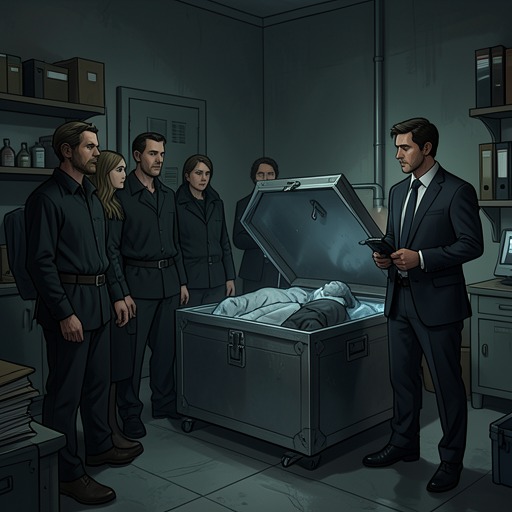
Ruziers Corporation’s most concrete operation is the movement of a shipment of humans. When Rayo warns Tom that Zon has learned about the shipment and is sending someone to collect it, Ruziers Corporation abandons stealth and assigns Rayo’s group to escort Tom to the shipment site and back. The corporation triples Tom’s retainer, revealing both the value it places on the cargo and the urgency created by Zon's intervention.
The shipment’s value is explained through a brutally classificatory logic. Humans are not recognized as a sentient species, while their supposedly universal DNA makes them commercially useful. Male humans can be sold to laboratories or private collections, whereas female humans can be sold under the Population Trade Act. The legal terminology functions as a thin administrative cover for sexual enslavement and reproductive exploitation. Sara understands that the women are being treated as breeding machines rather than as persons, and her concealed rage marks the moment when the corporation’s euphemisms are translated into their social and bodily consequences.
Ruziers Corporation’s trade therefore depends on a chain of reductions. A person becomes a shipment; a shipment becomes a price; sex becomes reproductive capacity; and law becomes a mechanism for laundering coercion. The corporation’s commercial vocabulary resembles neutrality, but every category distributes vulnerability. It determines who can be collected, who can be sold, which bodies are valuable, and which forms of violence can be presented as legitimate administration.
Conflict with Tom, Sara, and Zon
The corporation’s interests place it in direct conflict with Tom, whose public identity as Bond conceals his status as Zon's son and agent. Toridge discovers that Tom is the son of a warlord and warns him to leave immediately. Tom has already risked exposing his true name, and he fears that Ruziers Corporation will kill him if it learns his identity. The danger is doubled because Sara is human, making her both Tom’s Starmate and precisely the kind of person Ruziers seeks to control.
Rayo eventually identifies Sara as human and reveals that he suspected Tom’s connection to Zon. He threatens that the crew could kill Tom and take Sara, while pointing to Tom’s convenient arrival after his supposed escape from Flanard. The threat confirms that Ruziers Corporation does not merely authorize distant trafficking; its agents are prepared to enforce the corporation’s claim through murder and abduction. Tom responds by killing Rayo and the accompanying crew, while Sara uses a gun to help eliminate the survivors. Tom then turns his ship’s weapons on Rayo’s vessel rather than risk allowing the corporation’s forces to destroy or recapture them.
Zon represents a competing power because he champions the Human Rights movement and sends an agent to intercept the shipment. Tom refuses to confront Zon's people, recognizing that the corporation’s concern about the intervention reveals the true nature of its mission. The possibility that Zon might steal the humans becomes evidence that Ruziers Corporation is not constructing the sanctuary Tom had described. The corporation’s fear of rescue exposes its dependence on secrecy and its inability to defend the shipment as a humanitarian project.
Connections to Broader Systems of Control
Ruziers Corporation belongs to a wider economy in which bodies, blood, reproduction, labor, and identity are traded or negotiated. Elsewhere, people are offered money for serving as living blood donors, and vampire institutions calculate monthly payments, per-ounce compensation, and additional fees for sexualized feeding. Other characters bargain over debts, ransoms, marriage, and pregnancy. Against this background, Ruziers Corporation’s treatment of humans is not an isolated aberration but one especially stark expression of the book’s recurring exchange logic: intimacy can become a contract, a body can become collateral, and legal recognition can determine whether exploitation is visible.
The corporation also stands in contrast to the human-rights arguments advanced by Ana Medina and Senator Seth Fischer. Ana helps prepare Fischer’s speech opposing the Shifter Registry Act because she sees registration as a step toward detention and the stripping of civil rights. Her insistence that people remain people supplies a moral counterpoint to Ruziers Corporation’s classification of humans as non-sentient biological resources. Where the corporation relies on categories to deny personhood, the rights movement treats personhood as the ground from which law must begin.
Narrative Significance and Limits of Its Power
Ruziers Corporation is important less as a fully individualized institution than as a distributed antagonist. It is encountered through contracts, rumors, agents, transport arrangements, increased retainers, threats, and the fear that its personnel may identify a hidden heritage. This indirect presence gives the corporation a systemic quality: the danger does not depend on one villain’s personal obsession, because the institution can replace one agent with another and continue pursuing the same cargo.
Its power nevertheless has limits. The older T'shav hired by the corporation abandons the fight after recognizing Tom’s claim to his Starmate and interpreting the spirits as declaring Tom a god. Rayo’s crew is destroyed when Tom and Sara resist. Zon's intervention forces Ruziers Corporation to give up stealth and expose the scale of its operation. These reversals do not erase the trafficking system, but they show that its classifications are not universally accepted. The humans may be labeled cargo, laboratory specimens, or reproductive commodities by the corporation; through resistance, testimony, and alliance, they become people whose bonds and choices can interrupt the transaction.